
INSIGHTS
What independent schools need to know about parent decision making
How Would You Sell a $370K Decision?
Independent schools are often cost-conscious about everything except education. Yet when a family enrols a child, they are committing to a decision worth around $370,000 over 13 years, and they expect the experience to match.
Parents are not just enrolling a child. They are customers making one of the largest and most emotionally weighted decisions of their lives. Effective school marketing is essential to attracting and retaining these families, and it starts with understanding both students’ needs and parents’ motivations.
Key takeaways
- The most consistent reason parents choose an independent school is the promise to help their child fulfil their potential.
- The decision journey runs 3–7 years, so schools must nurture families long before they apply.
- Cost-of-living pressure hasn’t reduced demand for independent education. It has increased the scrutiny applied to it.
What Parents Actually Value
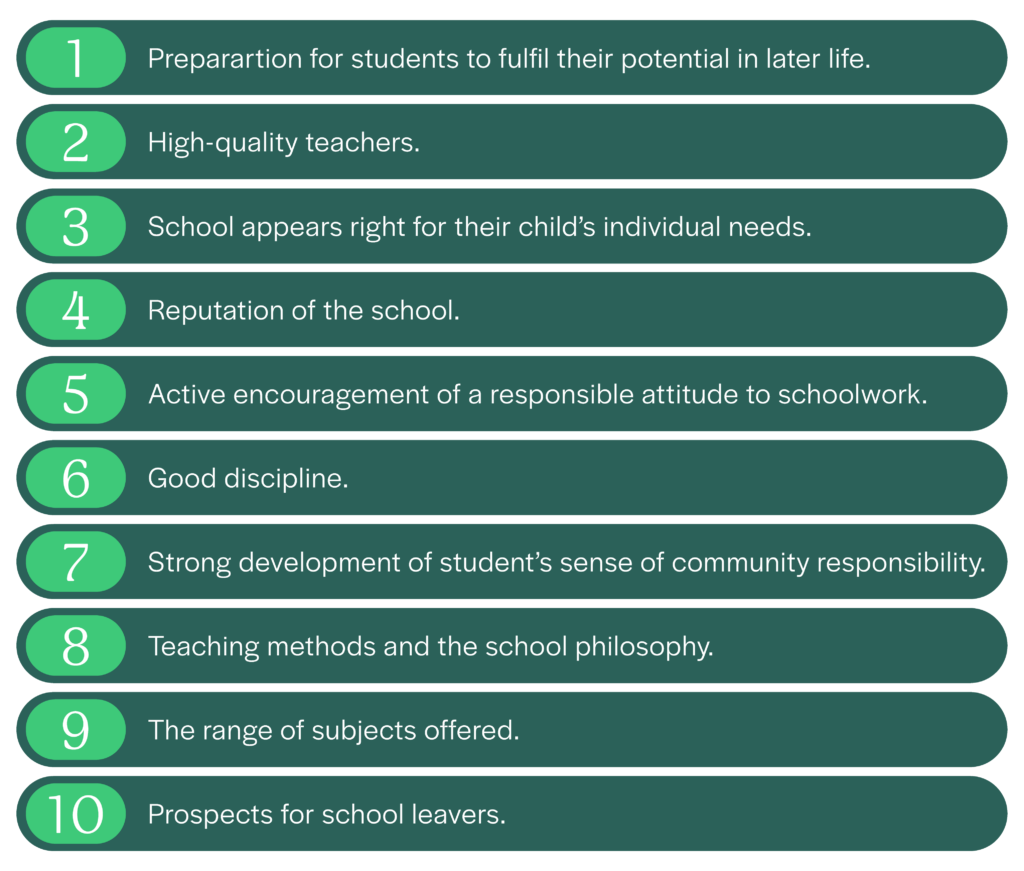
Independent Schools Queensland’s (ISQ) What Parents Want survey has tracked parents’ decision-making for 19 years, and its findings challenge many assumptions about school choice. The number one reason, unchanged throughout, is not academic rankings, fees or facilities. It is the promise to help children fulfil their potential. Every piece of school marketing should connect back to this driver.
Top 10 Reasons Parents Choose an Independent School
How Parents Make the Decision
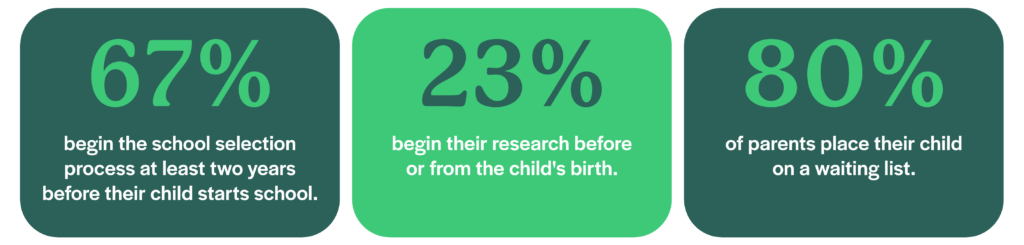
Independent school enrolment is not an impulse purchase. It is one of the most considered, long-horizon decisions Australian families make.
The typical enrolment journey spans 3–7 years from first awareness to confirmed enrolment. Schools are therefore not marketing only to people ready to decide. They are building relationships with families who are years away from applying, which requires a balance of brand building, long-term communication and tactical bottom-of-funnel activity.
What Influences the Decision?
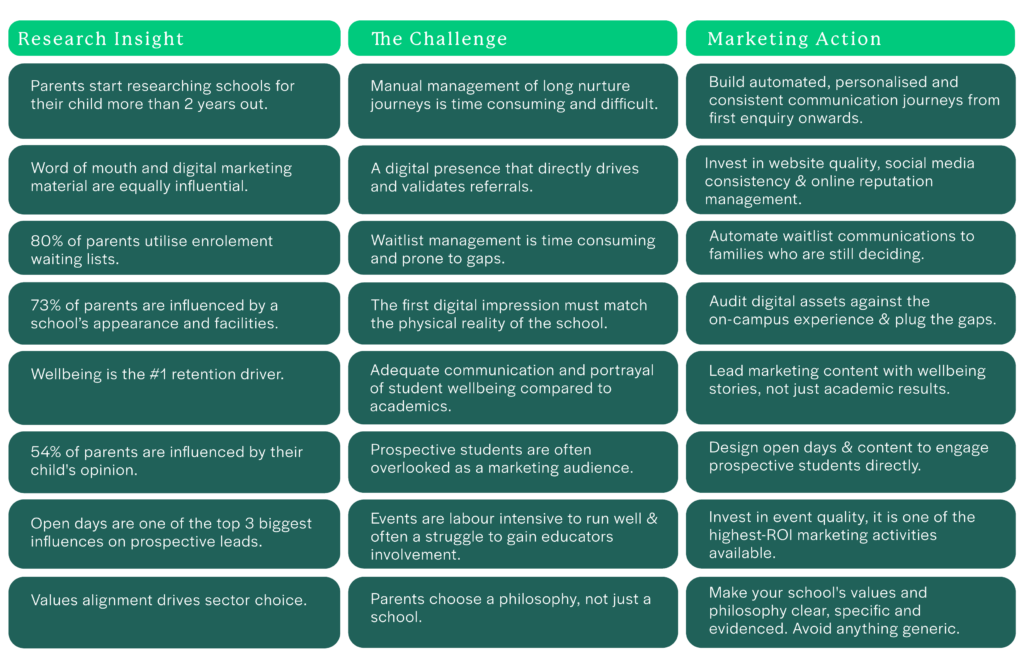
The ISQ survey identifies the information sources parents rely on most. Word of mouth and digital presence carry equal weight and reinforce each other: a strong reputation drives digital searches, and a strong digital presence validates that reputation. Focusing on one without the other will weaken the impression families form.
How Important Are Facilities and First Impressions?
Some 73% of parents say their school choice was totally or highly influenced by how the school looks and its facilities, up from 42% in 2006. Two shifts explain the rise:
- Parents’ expectations of facilities are increasing, likely in line with fees.
- Parents increasingly interact with schools remotely, so the visual quality of websites and social media directly shapes their perception of the physical campus.
Children’s Opinions Influence Decisions
Some 54% of parents say their child’s opinion was totally or highly influential in the final choice. This matters for open day design, student ambassador programs and content strategy. Student-led tours, outdoor advertising and elective subject offerings need to speak to prospective students as much as to their parents.
Values and Community Are Key Drivers
Parents behave like customers, but they choose like members. They are joining a community, and it must feel like it shares what they believe about how children should be raised, educated and prepared for life.
Research from the Australian Council for Educational Research, drawing on 609 families, found that parents choose schools that align with their values, and that those values differ meaningfully between schools and sectors. The Australian Institute of Family Studies’ longitudinal study of 8,000 families reinforced this: families choosing an independent school cited academic results as a motivating factor, but alignment with religious and philosophical values was equally significant.
Will the Growth Bubble Burst?
The cost-of-living pressures of the mid-2020s might seem like a headwind for independent schools. The data suggests a more nuanced picture, and we believe growth is likely to continue.
Why enrolments continue to grow
- Independent school enrolments rose 15.3% between 2021 and 2025, the sector’s strongest growth in decades, through a sustained period of household financial pressure.
- Many parents treat education as a protected investment, cutting discretionary spending before education commitments.
Where the growth is concentrated
- Lower-fee schools are growing fastest. The median fee of $5,537 per year [clarify what this measures, e.g. median across all independent schools] is accessible to a far wider range of families than commonly assumed.
- Schools serving ultra-high-net-worth families are typically less susceptible to enrolment shocks. Schools in the middle ground, with relatively high fees and competitive landscapes, need to plan for both the long and short game.
What Changes Under Financial Pressure?
Cost-of-living pressure does not reduce the desire to invest in education. It changes the nature of the scrutiny applied:
- Parents ask harder questions about value and outcomes before committing.
- They compare more cost-effective options and favour schools with transparent, inclusive fees.
- Every touchpoint, from website to welcome email to open day, is judged as evidence of school quality.
- Schools that communicate value clearly and consistently hold a decisive advantage over those relying on reputation alone.
Communication deserves particular attention. Parents consistently tell us that school communications are complex and uncoordinated, and families are increasingly sensitive to perceived waste, inefficiency or impersonality. Know your audience and consider ‘value’ from their perspective.

Wellbeing Drives Retention
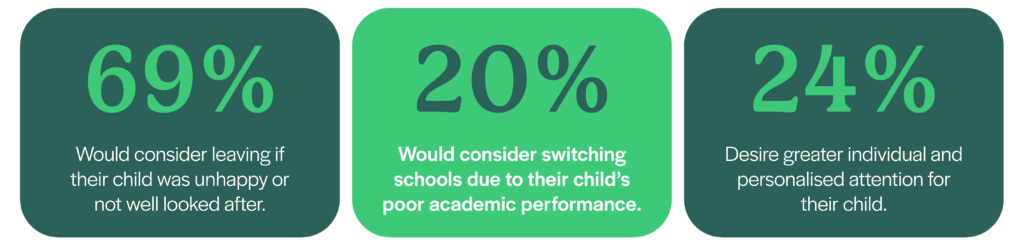
Once families are enrolled, they want more support in wellbeing programs (23%) and career and pathways guidance (20%) (Edstart, 2023). Academic performance matters, but for a significant segment of parents it is not the main emotional driver of retention. In short, potential and individual attention win the enrolment, and wellbeing keeps the family.
Implications for Marketing
For the School Council, Executive Team and School Principals
- Position wellbeing and individual attention at the centre of your school’s public narrative; these are the primary drivers of enrolment and retention
- Invest in open day quality as a strategic priority; it is among the highest-ROI activities available to a school
- Ensure your school’s values are specific, evidence-based, and visibly embedded in every stakeholder communication
- Recognise that the enrolment decision starts years before families apply, and build community trust over the long term
- Understand the lifetime value of an enrolled family: at an average of $369,594 per child (in metro areas) the financial justification for investing in marketing and enrolment experience is clear
- Review the total cost parents pay across all categories, including tuition, uniforms, camps, and co-curricular, and ensure communication articulates value
- Model marketing investment against enrolment outcomes: 2-3 additional family enrolments over 13 years significantly outweigh most marketing budgets
- Factor in sibling enrolments: a family with three children represents a potential $1.1 million lifetime investment in your school
Conclusion
The Australian independent school sector is growing. Parents are prioritising education even amid financial stress. But they are asking tougher questions, applying greater scrutiny, and expecting more from every interaction with the schools they are considering.
In this environment, the schools that will thrive are not those with the most impressive facilities or the longest history. They are the schools that understand what parents want: individual attention, whole-child wellbeing, values alignment, and community belonging, and that communicate these priorities with clarity, consistency, and warmth across every touchpoint in a relationship that begins years before enrolment.
The $370,000 decision deserves that level of care. And the families making it deserve schools that meet them where they are. We help connect the dots to strengthen independent school brand reputation and enrolments. Get in touch to drive your school marketing and admissions performance.
Sources: IBISWorld (2024) | Independent Schools Queensland — What Parents Want Survey (2025) | Independent Schools Australia | Edstart Parent Survey (2023) | Australian Bureau of Statistics | Australian Council for Educational Research | Australian Institute of Family Studies | ComparPrivateSchools.com.au | The Educator Online