
INSIGHTS
Go to market problem solving
The type of problem you’re solving impacts your Go-to-Market strategy
Many of us have a product or service love that seemingly solves a problem and beautifully enhances our daily lives. The bottom line is that these solutions can come from known and unknown problem sources. Identifying if your innovation is solving a known or unknown problem is essential to successful go-to-market planning.
Known Problems versus Unknown Problems
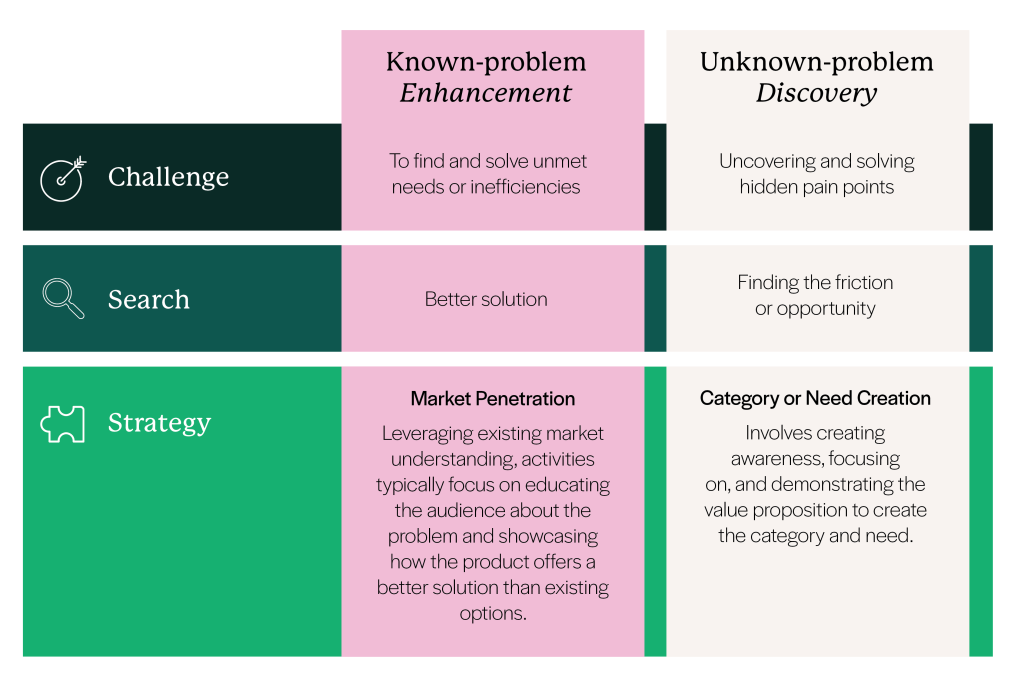
Known problems are issues your team acknowledges, focusing on understanding existing solutions and competitor offerings, and on identifying unmet needs or inefficiencies. Once solved, these problems are easier to scale and commercialise because you’re meeting an identified need.
In our experience, discovery-driven innovation presents different market challenges that are often overlooked in the business case and underestimated in the planning stages. These ultimately impact scaling and commercialisation. Distinguishing these early can be mission-critical for achieving success and reducing risk.
Identify the problem you’re solving
The risks of the unknown problem
Solving unknown problems is inherently riskier. The problem’s uncertainty requires prospective customers to discover, understand, and acknowledge it. The problem must ‘feel’ sufficient to warrant behaviour and attitudinal change.
Discovery-led innovation mostly requires market creation, which demands different strategies, capital requirements and ramp-time to market.
If the reward isn’t forthcoming
Research shows that 85% to 95% of new products and services launched fail to scale and commercialise*. Early identification of the problem you’re solving and a sound Go-to-Market strategy certainly help mitigate risks.
This should always include a solid product strategy and the open-mindedness and agility to adapt offerings or broaden application considerations if the problem isn’t sufficient to sustain a market. It’s always worth remembering that Post-it Notes, Viagra, Teflon, Pinterest, WD-40, Penicillin, and microwave popcorn have all achieved ubiquitous status yet started as solutions to very different problems.
If your growth trajectory isn’t delivering what you’d hoped, take a step back and challenge yourself to consider;
- Am I solving a known or unknown problem?
- Is my understanding of the challenge correct, and am I approaching the challenge in the right way?
- How big is the problem I’m solving relative to everything else in your customer’s life?
- How entrenched are brand preferences, customer, and category behaviours?
- Is the challenge realistic, given the available time and investment? Consider how the challenge can be contained and resources focused on impact.
Most innovation journeys benefit from a fresh perspective; adapting and planning for change are essential when needed. If your product or service investment isn’t delivering the commercial results you need or anticipated, reach out to have a confidential chat. As good karma creators, we’re happy to invest the time to chat.
* Clay Christensen, Scott Anthony, and Erin Halloran’s research was published in the Harvard Business Review.