
INSIGHTS
Is your marketing function resourced, structured and optimised to deliver commercial impact?
Most Australian B2B marketing teams are busy. Very few are continuously effective. The gap between activity and commercial impact has never been wider, and local businesses are paying for it. Before diving into any marketing strategy, it’s essential to ask: Is your marketing driving revenue and long-term impact? The difference between marketing perceived as a cost centre and marketing that drives revenue comes down to one thing: commercial discipline. Is your marketing driving revenue and long-term impact is the question every marketing leader must be able to answer. The willingness to focus on what matters, measure impact honestly, and divest ruthlessly from everything else.
This is harder than it sounds. Every year brings a new platform, a new framework, and a new priority that demands attention. Each time a team chases it, they drift further from the work that builds company value — and from the outcomes their CEO cares about. But is your marketing driving revenue and long-term impact at every turn? The marketing function that earns its seat at the table isn’t the one with the biggest budget. It’s the one that can prove the worth of its work.
Australia’s marketing efficiency deficit
Australian B2B marketing is lagging — not just in spend, but in strategic maturity. The numbers tell a clear story.
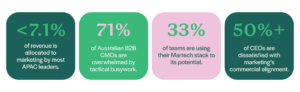
Global B2B marketing budgets typically range from 7.7% to 8.4% of revenue. Most APAC leaders are investing below that floor — then wondering why results are thin. The problem isn’t just underfunding. It’s that the spend that does exist is poorly directed: CMOs are buried in execution, martech sits idle, and the majority of marketing funnels leak value at every stage. This is what a commercial discipline deficit looks like in practice. And it’s exactly what leads business owners, CEOs and CFOs to question whether marketing is worth the investment at all. In fact, asking if your marketing is driving revenue and long-term impact has become more crucial than ever.
Three places to start
Strategic transformation takes time. But commercial clarity can be created quickly — by making deliberate choices about where not to spend effort and money.
- Divest from misaligned activity. Shut down campaigns, programs and channels that don’t connect to a commercial outcome. This includes anything that’s low performing or misaligned. Revenue is an output, not a strategy. If the activity doesn’t map to a clear business priority, cut it.
- Rationalise the tech stack. Most martech is not the problem — underuse is. Before adding tools, audit what exists. If something isn’t being used or isn’t delivering, the issue is usually implementation, training, or relevance. Be ruthless about which of those problems is worth solving.
- Invest in human connection. Australian B2B buyers are telling us they want less automation and more substance. Shift budget toward subject matter experts, roundtables, and face-to-face events that build genuine relationships with the buyers who actually make decisions.
Is your B2B marketing team performing how it should?
Quick wins only go so far. The deeper question is whether the marketing function is structured to sustain commercial performance — or whether it keeps reverting to the same patterns under pressure. Above all, is your marketing driving revenue and long-term impact?
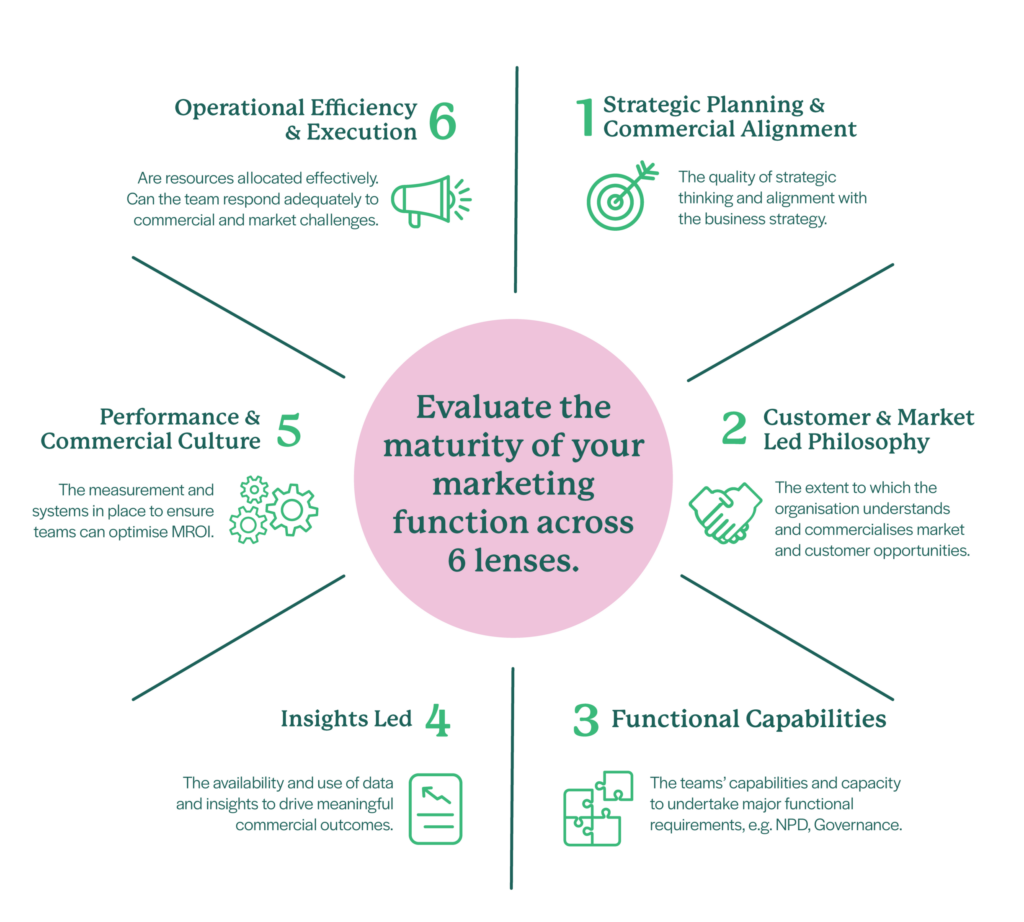
Our marketing maturity model evaluates teams across six dimensions to identify where modernisation is needed and where investment will actually pay off. Each lens unpacks critical areas within the marketing function, their direct alignment with commercial outcomes and opportunities, and areas for investment and efficiency.
Most marketing teams aren’t underperforming because they lack effort. They’re underperforming because no one has asked the hard questions.
How to evaluate if your marketing function is set for success?
The emmet marketing audit assesses
- Commercial direction: Do you have clear strategic leadership and align marketing activities with long-term and short-term business goals
- Market-led philosophy: Is the team genuinely close to its customers and actively commercialising what it learns?
- Capability: Does the team have the capabilities, capacity and applied knowledge required to execute modern marketing
- Insights-led: Are the data and AI tools available, understood, and used to inform decisions?
- Performance and Commercial Culture: Are the systems and processes in place to enable the team to test and learn freely and with insight?
- Operational efficiency and execution: Can the team reliably deliver — on time, on brief, and to a standard that reflects the brand?
Together, these dimensions help marketing and business leaders redesign their function’s strategy, operations, and culture to be fit for commercial purposes — and capable of creating the value the business actually needs.
We believe marketing is a craft — requiring foresight, commercial creativity, and operational excellence. Done well, it builds sustainable value for customers and the company alike. The era of playing it safe isn’t over. It never really existed. The teams that win are the ones who’ve always been willing to be held accountable for what they produce.
Curious where your team sits on the maturity model? We can walk you through it.
Last thought from us. Profitable operations and growth don’t happen by accident. It takes sharp strategy, marketing that moves people, and sales capability that converts. We’ve built our expertise across global enterprises, private equity, consulting, marketing agencies, and ASX-listed scale-ups — blending commercial rigour with creative edge and a bias for action. We help you take the strategic leap: modernise, transform, and compete harder without losing momentum and, critically, without losing sight of what made your business and brand great.
Get in touch B2B Services
Sources quoted include Gartner, Forrester, and AMI.