
INSIGHTS
Company Strategy Adaptation for Today’s Leaders
The Strategy-Governance Intersection: Turning Oversight into a Competitive Advantage
Whether it is the rise of Agentic AI, the fragmentation of global supply chains, or the volatility of the modern talent market, Boards are discovering that 20th-century Corporate Governance Frameworks—designed for a predictable world—are no longer fit for purpose. These frameworks are failing to meet modern demands. Notably, company strategy must now adapt to more unpredictable environments.
Through our strategic collaboration with CSB Corporate Services, we have noticed a recurring issue among Executive Leadership Teams: the Execution Void. This happens when a brilliant, Board-approved strategy is hindered by misaligned Corporate Governance.
No matter how strong the strategy is, an inconsistent operating model leads nowhere. To address this, we recommend that Boards shift from viewing Corporate Governance merely as a compliance task. Instead, they should recognise it as a strategic tool for facilitating change for the ultimate benefit of staff and Shareholders. For Boards, company strategy and governance need to act in concert for sustainable transformation.
Mind the Gap: The Strategy-Governance Divide
When there is a disconnect between how a Board manages risk and how the Executive Leadership Team drives growth, the organisation loses its ability to pivot. Take AI as the primary example. In fact, a company’s strategy often depends on the adaptability of this governance.
However, if the Board hasn’t developed parameters within the Corporate Governance Framework to oversee algorithmic ethics or data sovereignty, the result is either a commercial blocker or a catastrophic compliance failure. In either scenario, both parties fail strategically. Good Corporate Governance isn’t a brake; it’s the steering system that allows the vehicle to travel safely at higher speeds. In fact, a company’s strategy often depends on the adaptability of this governance.
Plugging the gap: Achieving strategic nirvana
Nirvana state is where the Board and Executive Leadership Team operate at different altitudes but work in perfect harmony—one mapping the long-term journey, the other defining the rules of the road.
Company Strategy | Defines the competitive edge and operational implementation, demanding consistent decisions on where to allocate limited resources.
Board Strategy | Provides stewardship over viability and long-term value, focusing on capital allocation, risk appetite, and the ethical guardrails that protect the organisation’s license to operate.
At a Glance: Different Altitudes, One Direction

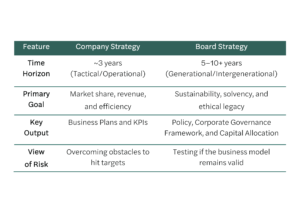
Why does distinction matter?
If a Board becomes too involved in company operations, it risks descending into micromanagement and losing objective oversight. Conversely, if it is too detached, it becomes passive and fails its fiduciary duty—as seen in the recent entertainment case in Australia. The Board’s role is to set strategic direction and scrutinise the pathway to ensure a company is resilient, ethical and properly funded.
As BCG suggests, Corporate Governance must match the environment. You cannot govern an adaptive tech firm with a rigid compliance framework suitable for a 1990s industrial giant. This is why we partner with the team at CSP—to help organisations define their strategy and align it with a Corporate Governance Framework tailored to their specific strategic environment. As a result, organisations receive tailored support. Ultimately, company strategy is only as effective as the governance that supports it.
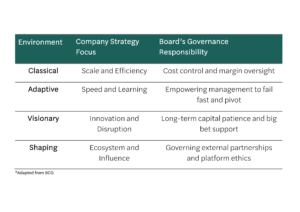
The Bottom Line: Alignment Pays Dividends
There is a direct correlation between Corporate Governance maturity and financial performance. According to PwC, Boards that share real-time digital Corporate Governance tools with their Executives are three times more likely to make successful strategic pivots.
In 2026, the most dangerous risk a Board can take is maintaining a Corporate Governance Framework designed for a world that no longer exists. As a result, this approach jeopardises the company’s future. Those embracing adaptive oversight through aligned visions and strategies stand the best chance of long-term success.
Is your Board ready for the complexity of 2027?
In partnership with CSB Corporate Services, Emmet Consulting assists in aligning Board-level intentions with organisational reality. Reach out to us today to stress-test your strategy and choose our planning priority workshop to sharpen your strategic planning agenda.
Get in touch today