
INSIGHTS
Change management won’t transform your business. Here’s what will
Change management won’t transform your business. Here’s what will.
Most organisations mistake motion for progress. They bring in a change manager, run the workshops, tick the boxes, and wonder why nothing fundamentally shifts.
Here’s the uncomfortable truth: change management and business transformation are not the same thing. Confusing the two is costing Australian businesses millions in real costs, lost opportunities, and wasted momentum. Transformation doesn’t come from managing change well. It comes from having a clear commercial strategy in the first place. A change manager’s job is to execute a strategy — not to create one. Hire them before that strategy exists, and you haven’t solved your problem. You’ve just given it a job title.
What is a commercial strategy?
Commercial strategy is the discipline of understanding how a business creates, captures, and sustains value in the market. It sits at the intersection of revenue, operations, customer relationships, and cost structure, asking not only what a business does, but also how it makes money and whether that model is built to last. It identifies where genuine value lies, where it is eroding, and how an organisation can grow with intention by aligning every function with a coherent commercial logic.
Change management vs. transformation: not the same thing
Boardrooms and project briefs use these terms interchangeably. That habit is costly. They describe fundamentally different scopes of work. We see all too often organisations bringing in a change manager and expecting transformation. The two are not the same. The fact is, a transformation can only occur when you have a clear commercial strategy. The role of the change manager is not to create the strategy but to help execute it. One is a subset of the other, and this confusion is costing Australian businesses millions in real and opportunity costs. You’ve all seen it, at some time or other. A change manager is appointed, and things end up different, but no better, or even worse than they were in the first place.
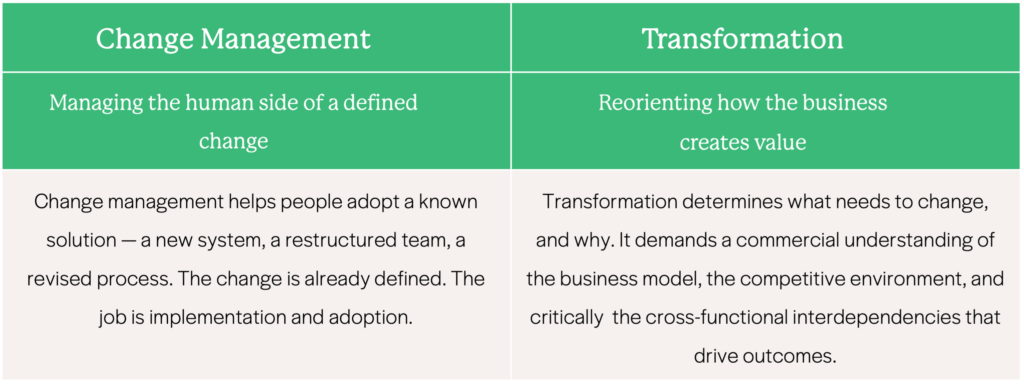
Change management is a subset of transformation. A genuinely transformative business will draw on change management throughout. But bringing a change manager in to lead the transformation is like hiring a project manager before you have a project. The diagnosis comes first.
“Getting a change manager in will not transform your business. Transformation requires understanding the commercial engine before you start moving its parts.” Lisa Edmonds, Emmet Consulting
What transformation demands that change management overlooks
1. Commercial principle: understand the commercial drivers
Transformation must start with a commercial understanding: how the business makes money, what drives revenue and costs, where margins are built or eroded, and which customer segments are genuinely viable. Without this foundation, change programmes optimise the wrong things. It’s equally important to understand what the business can actually change and what that change costs. Too many organisations restructure, re-platform, or redeploy resources without first answering a simpler question: Does this make us more commercially competitive? Will it add long-term value? Or does it just signal movement, like a quasi-government department shuffling the deck?
2. Operating principle: keep the business moving
Transformation does not happen in isolation from the trading business. The business still needs to generate revenue, and forecasts typically rise to fund the transformation itself. Teams still need to serve clients. One of the most common failures in large-scale programmes is assuming the business can pause while the future takes shape. It can’t.
3. Momentum principle: quick wins
We identify quick wins and near-term efficiencies early, not as the end goal, but as a signal of momentum. They fund belief, free up capacity, and keep the organisation moving while longer-term structural changes take shape.
4. Capability principle: the step most strategies skip
Capability planning is a consistent theme in our work because most strategies ignore it entirely. Organisations define what they want to change but rarely test whether they have the people, skills, and structures to deliver it. They build the plan, then assume the capability will follow. It rarely does. Defining the requirements for change and honestly testing them against current capabilities is not optional; it is the step that separates strategies that land from those that stall.
5. Collaboration principle: change cross-functionally, or not at all
This is where change management most consistently fails. A change management programme operates within a defined function or workstream. But a business’s commercial levers rarely sit within a single team. Pricing decisions cut across finance, sales, and operations. Customer experience touches technology, product, and people. Cost structures span procurement, HR, and every P&L owner in the business.
A transformation that ignores cross-functional interdependencies doesn’t transform it displaces. Drive efficiencies in one area, and the cost reappears somewhere else. Optimise one function without aligning the ones around it, and the gain is temporary at best, and damaging at worst.
A process built around sustainable value
Effective commercial transformation follows a clear sequence, not because processes are comforting, but because sequencing prevents the most common failure modes.
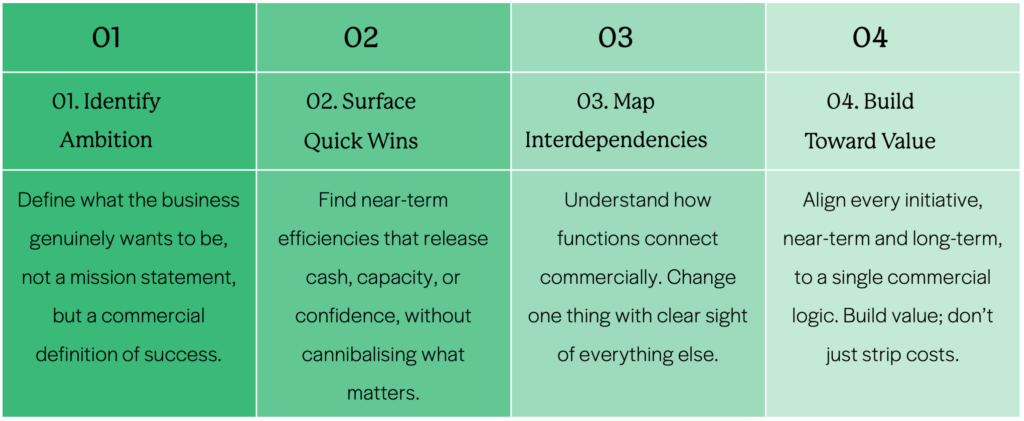
The goal is not to drive efficiencies somewhere at the cost of something else. It is to build an organisation that is more commercially intelligent, more operationally coherent, and more resilient, not just leaner in one place and more fragile everywhere else. The test of any transformation is whether the sum of the changes in cost, capability, customer value, brand, and people culture leaves the business in a more sustainable competitive position than before. Critically, this must hold over the short and medium term.
We develop our insights from on-the-ground experience and lessons learned. Yes, sometimes, this is the hard way. We work with leadership teams across B2B and Education to identify commercial ambition and help make it happen with cross-functional programs that deliver tangible results.